
I have a friend who recently took a holiday in Belize with his family. While there he visited a Mennonite community that was established there in 1958.
These are some of Kevin Neilsen’s thoughts on the experience. He’s a fine storyteller; quite an accomplished photographer as well.
His link:
https://www.instagram.com/jkneilson?igsh=NTc4MTIwNjQ2YQ==
His piece:
“Just outside Armenia, Belize, my son Gavin and I visited a place called Springfield.
It’s a traditional Mennonite community—about a hundred families—and it’s bounded in a way that goes beyond mere geography.
There’s the village, and there’s The Outside. The boundary is crucial to their way of life.
The people here are gifted agriculturalists working entirely with pre-industrial technology: wheels, plows, buggies, spades, shovels, pitchforks. There’s no electricity. No running water. There are no phones, cars, or refrigerators.
While they can’t own post-industrial technology, they can use it when they’re in The Outside. For instance, a family can ride their horse and buggy to the edge of The Outside, hobble the horse for the day, then take a bus into town to purchase something they can’t grow or make themselves.
Everything runs on brute physical power—human and horse. There’s a horse-powered mill that processes raw lumber into neatly planed planks, using just muscle and torque.
They grow flowers, citrus, potatoes, carrots, onions—anything that does well in the valley. They raise chickens, goats, cattle, rabbits, parakeets, and even hamsters. Much of this is for their own use, but a great deal of it is sold to The Outside, with whom they maintain close economic ties. In fact, The Outside depends on them for milk, meat, eggs, and lumber.
The village itself is connected by a long meandering dirt road. Energy’s a scarce resource, so if someone wants to visit a neighbor a quarter mile away, he or she will often take a horse and buggy. Walking’s expensive when every calorie counts.
Labor is often pooled. It’s normal for 20 or 30 people to build a functioning house in two or three days—sometimes in a single day if everything goes smoothly.
Horses are lent freely. A neighbor will borrow one for plowing or transport, and when the work’s finished, the horse gets a slap on the rump and canters home on its own, half a mile away or more.
They speak fluent English, Spanish, and Low German. The women are shy and modest, and they’ll wave if someone from The Outside waves first. The men are lean, strong, and generally happy to talk.
I asked many questions about sanitation, schooling, religion, authority, punishment. Villagers patiently answered them. And then, without fail, they asked me the same set of questions in turn: What’s your weather like? How much rain do you get? How cold is it? How hot? When does the sun rise and set?
As agrarians, those questions go to the heart of the matter. Everything else is irrelevant.
One man was genuinely baffled when I told him that in California we sometimes have firestorms that destroy entire towns and consume half a million to a million acres over months.
“That makes no sense to me,” he said. “If I see smoke a mile away, I know it can’t possibly reach me. My family and I are safe. It makes no sense.”
The men are anti-fragile in the extreme. One apologized mid-conversation because his attention was drifting. “Sorry,” he said, “I got rolled by my horse this morning, and I’m hurt.” Ten minutes later, he limped back to work.
From what I observed, the men place a low premium on personal hygiene. They rarely bathe, comb their hair, brush their teeth, or wash work clothes—presumably because they know they’ll be filthy again within hours.
The schoolhouse is also the church, and the church is also the civic hall. Children ages six to 18 are taught under one roof, where beliefs and values are transmitted, and practical village matters discussed and resolved.
The village has a Chairman. He’s elected democratically and can be unelected the same way. He’s always male, and usually wealthy—wealth here meaning horses, cattle, fertile land, and surplus. Surplus is a sign of sound judgment.
The Chairman oversees education, religion, and logistics, and acts as liaison to leaders and
politicians in The Outside.
Trust is woven into daily life. Flowers and eggs are sold at roadside stands using nothing but the honor system—even with outsiders. It makes sense. One person managing transactions is better employed at home, in the fields, or at the nursery.
Efficiency here isn’t technological. It’s moral, social, and physical. And it works for them.
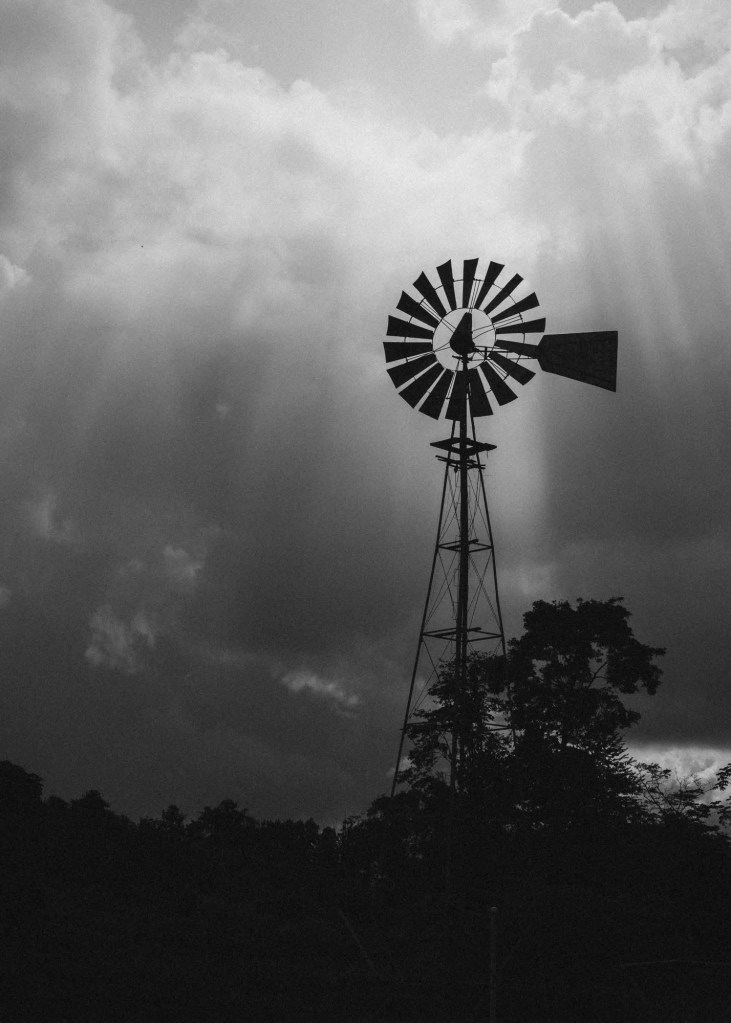
Although I’m a photographer, I made only one photograph here—a windmill. Photographing the people felt disrespectful.”
 1/2_Full, All GOOD